
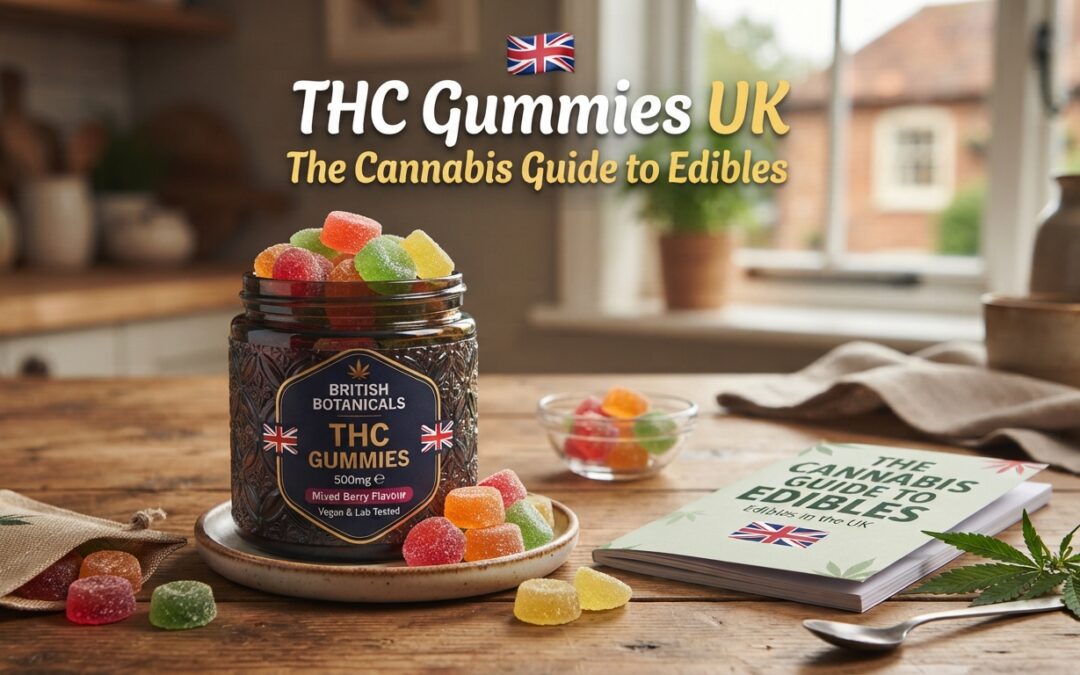
THC Gummies UK: Understanding the Law, Ingredients and Health Risks
An educational guide explaining what THC gummies are, how they differ from CBD gummies, their legal status in the United Kingdom and the important safety considerations surrounding cannabis edibles.
Updated: October 2026
What Are THC Gummies?
THC gummies are edible products that contain tetrahydrocannabinol, commonly abbreviated as THC. THC is one of the principal cannabinoids associated with the cannabis plant.
Unlike cannabidiol (CBD), THC can produce intoxicating effects and can alter perception, attention, coordination, memory and judgement. The effects vary according to the individual, the product and other circumstances.
Gummies are particularly important to discuss from a public-health perspective because they can resemble ordinary sweets. Their appearance does not indicate whether they contain controlled substances or whether the declared ingredients are accurate.
The term "THC gummies UK" frequently appears in online discussions, but a product appearing in UK search results does not establish its legal status, quality or safety.
Are THC Gummies Legal in the UK?
THC is controlled under UK drugs legislation. Cannabis remains a Class B controlled drug, and unauthorised possession and supply can constitute criminal offences.
The legal position depends on the product's actual composition, its classification and whether a relevant legal authorisation or exemption applies. Simply describing an item as hemp-derived, natural, edible or low-strength does not automatically make it lawful.
The Home Office provides detailed information about the controls applying to cannabis, CBD and other cannabinoids. Readers should consult its official cannabinoid licensing guidance.
For a more focused explanation, see our related educational article on whether cannabis edibles are legal in the UK.
THC Gummies vs CBD Gummies
THC and CBD are different cannabinoids. Although both can occur in cannabis plants, they have different pharmacological properties and different legal considerations.
| Characteristic | THC Gummies | CBD Gummies |
|---|---|---|
| Principal cannabinoid | Tetrahydrocannabinol | Cannabidiol |
| Intoxicating effects | Can cause intoxication | CBD itself does not typically cause intoxication |
| UK legal considerations | THC is controlled | Depends on composition and applicable regulations |
| Product quality | Cannot be established from appearance | Cannot be established from appearance |
| Potential interactions | May interact with medicines | May interact with medicines |
CBD products are not automatically lawful merely because CBD itself is not a controlled drug. Other cannabinoids, food regulations and product composition may affect their legal status.
Read more in our THC vs CBD comparison.
Why Cannabis Edibles Require Particular Caution
Delayed and Unpredictable Effects
Edible cannabis products can have delayed effects compared with inhaled forms. This delay can make the experience difficult to predict, particularly when the amount of THC in a product is unknown.
Products obtained from unregulated sources may contain different quantities or substances from those stated on their packaging.
Accidental Exposure
Gummies, chocolates and other edible formats may resemble conventional food. This creates a risk of accidental ingestion, particularly among children and other vulnerable individuals.
Any suspected accidental ingestion involving a child should be treated seriously. Seek urgent medical advice, especially if the person becomes unusually sleepy, confused or unwell.
Effects on Mental and Physical Health
THC may impair coordination, concentration and decision-making. It can also produce anxiety, dizziness and other unwanted effects.
Regular exposure to cannabis containing THC is associated with additional health concerns, including dependence and mental-health risks. These concerns are especially important for young people because the brain is still developing.
The NHS medical cannabis guidance discusses possible adverse effects and the importance of clinical supervision.
What Is Delta-9 THC?
Delta-9-tetrahydrocannabinol is the best-known intoxicating cannabinoid found in cannabis. In many everyday discussions, the abbreviation THC refers specifically to delta-9 THC.
The presence of delta-9 THC in an edible product is relevant both to its effects and its regulatory classification.
Different cannabinoid names should not be treated as evidence that a product is legal or safe. Chemical identity, composition and applicable legislation all matter.
See the related article: Understanding Delta-9 THC.
Medical Cannabis and THC in the UK
In November 2018, UK regulations changed to establish a legal route for certain cannabis-based products for medicinal use.
This change did not legalise recreational cannabis products. Medical cannabis remains subject to strict prescribing and supply rules.
Specialist medical practitioners can prescribe certain cannabis-based medicines where clinically appropriate and legally permitted. The availability of these medicines depends on the patient's circumstances and the applicable clinical framework.
A commercially advertised THC gummy should not be confused with a properly prescribed cannabis-based medicine.
Medical Cannabis: Key Distinctions
- Medical use operates within a regulated framework.
- Clinical assessment is required for prescribing decisions.
- Not every cannabis-containing product is a medicine.
- Online advertising does not establish medical authorisation.
- Medical claims require appropriate supporting evidence.
Learn more from our educational overview of medical cannabinoids in the UK and our explanation of UK medical cannabis regulations.
Why Product Labelling Matters
Accurate product information is an important aspect of consumer protection. Labels can be misleading when they contain unsupported claims, incomplete ingredient information or inaccurate cannabinoid descriptions.
Packaging that resembles familiar confectionery can also create confusion about the nature of a cannabis-containing product.
The presence of a batch number, laboratory logo or quality claim should not automatically be treated as independent proof of safety. Such claims need to be verifiable.
Common Misunderstandings About THC Gummies
"Natural Means Safe"
A substance originating from a plant is not automatically harmless. Natural compounds can have significant biological effects and may interact with medicines.
"Hemp-Derived Means Legal"
The origin of a cannabinoid does not, by itself, determine whether a finished product is lawful in the United Kingdom.
"Edibles Are the Same as Ordinary Sweets"
Cannabis edibles can contain psychoactive substances. Their confectionery-like appearance does not make them equivalent to ordinary food.
"All Cannabis Products Are Medical Products"
A product containing cannabis or cannabinoids does not automatically qualify as an authorised medicine. Medical classification and supply are governed by specific regulations.
Understanding UK Cannabis Regulation
The most reliable approach to questions about THC gummies is to distinguish between controlled recreational products, lawful medicines and other cannabinoid-containing preparations.
Product names and advertising descriptions cannot replace an assessment of the applicable legislation.
Frequently Asked Questions
Are THC gummies legal in the UK?
THC is controlled under UK law. Ordinary recreational THC gummies should not be assumed to be lawful. Specific medical and other regulatory exemptions may apply in limited circumstances.
Are THC gummies and CBD gummies the same?
No. THC and CBD are different cannabinoids with different effects and regulatory considerations.
Can THC gummies cause intoxication?
Yes. THC can produce intoxicating effects and impair attention, coordination and judgement.
Are cannabis edibles approved medicines?
Not automatically. A cannabis edible is not an approved medicine simply because it contains a cannabinoid.
Can THC interact with medication?
Yes. Cannabinoids may interact with other medicines. A qualified healthcare professional should assess relevant medical concerns.
Does an online product listing establish legality?
No. Online availability does not establish that a product can lawfully be possessed, supplied or imported.
Why are cannabis gummies a concern for children?
They may resemble ordinary sweets, creating a risk of accidental ingestion. THC can have particularly concerning effects on children and young people.
Final Thoughts
Understanding THC gummies in the UK requires more than recognising a product name. It involves understanding cannabinoid chemistry, the legal framework, health risks and the limitations of product claims.
THC and CBD should not be confused, and recreational cannabis edibles should not be presented as equivalent to properly regulated medical cannabis products.
For accurate information, readers should prioritise official UK regulatory guidance and established medical sources over unsupported online claims.